Home Past Papers of NUST Website
Recommended Post : Online Preparation for NET-3

Showing posts with label Mcqs. Show all posts

Thursday, November 7

Solution to FMDC Paper

By With No comments:


FMDC 2012 Paper

Q10. If in a parallel plate capacitor we insert a metal sheet of half the thickness as compared with the spacing between the plates of the capacitor, the capacitance becomes...?
A) C/4
B) C/2
C) 2 C
D) 4 C
E) 0.5 C


Solution :
When the metal plate is inserted we get the following situation:


The red box shows a metal sheet of thickness d/2. The green colored plus and minus signs represent the charges on the plate of capacitors. When the metal plate is inserted the negative charges on the plate are attracted by the positive plate and positive charge are attracted by a negative plate, as shown above. This gives us two capacitors with the distance d/4 between them.
The original capacitance was:
C = ∈A/d
New capacitance of each capacitor will be :
C' = ∈A/d/4 = 4 ∈A/d = 4C
Now we have to identical capacitors in series, so there equivalent capacitance will be 2C .

1/Ceq = 1/C1 + 1/C2 for series combination of capacitors. 
Read More

Wednesday, November 6

MCQs of Organic Chemistry

By With 19 comments:

Here are the MCQs of Organic Chemistry from different Past Papers, you will find that most of them are easy and are from the text books.
So in order to score good in Chemistry you must have a strong grip on your text books. We have been collecting these from a year from different papers, we will continue to add more mcqs with the time .

Posting in a single file wont be fine, as we have observed you people feel it a burden, so we will provide these mcqs in parts. 35 mcqs in each part.

Papers:


Answer Keys:


Read More

Monday, November 4

Practice Questions for FMDC (Part 5)

By With 1 comment:


H = I2Rt
Where I2R = electrical power = 100 watts and time = t = 1 hour = 3600 sec
H = 100 x 3600
H = 360000


Like charges repel each other and unlike charges attract each other.
So electron (negatively charged) will move towards the positively charged plate, which is the upper plate in this question.


A good fuse must have minimum resistance because it has to melt whenever a large amount of current passes through it and it must not obstruct the wiring in circuit if it consumes extra electrical power.


6 ohms
Since two resistors of resistance 6 ohms are in parallel so their equivalent (3 ohms : 1/Re = 1/6 + 1/6) is in series in with the third resistor having 3 ohms. That equivalent 3 ohm resistance is series with the third 3 ohm resistor giving an equivalent of 6 ohms.


Remember this mnemonic
BB ROY Goes to Britain Via Germany West
Black = 0 Brown = 1 Red = 2 Orange = 3 Yellow = 4 Green = 5 Blue = 6 Violet = 7 Gray = 8 White = 9
(Capital letters are main focus in mnemonic)
There are four rules to read the color code defined in book.
The color code in our question is
White , violet, red
As first band indicates the first digit of numerical value of resistance and for white we know it is 9 so first digit of numerical value of resistance is 9
Now second band which is violet in color gives the second digit of value of resistance as violet indicates 7 so the second digit is 7
The color code upto this point gives a value of 97
Now look at the third band it is red in color, the third band gives the number of zeroes after the first two digits like in our question the third band is red in color red has value of 2 this means there will be two zeroes after the first two digits. So the final numerical value of resistance is 9700 ohms.


Semi-conductors
Substances having resistivity value between 10^-4 to 10^4 are semi-conductors.


Distance.
Application of Doppler effect, red colored star means longer wavelength which in turn means moving away from the observer.


Remains the same provided mass per unit length or density of the string remains the same.
As f= √(T/m)/2L
f'= √(T'/m)/2L'
Since T’ = 4T and L’ = 2L so
f'= √(4T/m)/4L
f'= (2 √(T/m))/(2×2L)
f^'= 2/2 (√(T/m)/2L)=f


Turns violet gradually
When a star accelerates towards earth the wavelengths constrict and wavelength becomes short and spectrum shifts towards violet portion.


Both ‘a’ and ‘e’
When light travels from one medium to other its frequency remains the same but speed and wavelength changes both have inverse relation with refractive index.
Refractive index of water is more than air which means light will travel slower in water due to its medium density i.e. higher refractive index and it will move faster in air than in water due to lesser value of refractive index of air.
And when light travels from one medium to other there may or may not be a phase change and it does refract making total internal reflection possible.

Read More

Saturday, November 2

Practice Questions for FMDC (Part 4)

By With 3 comments:


Answer: xerophytes


Answer: Hypotonic aquatic
The fresh water is relatively hypotonic to internal environment i.e. it is much diluted and has very less salts. Thus animals inhabiting fresh water constantly face the osmotic flooding of body fluids and loss of salts.fresh water animals including fishes remove excess water by producing large volumes of very dilute urine thus efficiently removing large quantity of water.

Answer: Leaves


Answer:Insects


Answer: Synovial Joints


Answer: somatic nerves


Answer: Ball and Socket Joint


Answer: One


Answer: Myosin only


Answer: Radius
Brachioradialus is inserted in radius when it contracts it lifts radius.
Read More

Physics Chapter 8 Part 1

By With 25 comments:

Topics Covered: 

  1. Transverse and longitudinal waves
  2. speed of sound
  3. super position
  4. interference
  5. beats
  6. reflection of waves
  7. stationary waves
  8. Doppler effect


1) a siren emitting a note of frequency n is fitted on a police van, traveling towards a stationary listener. What is the velocity of the van, if the frequency of the note heard by the listener is double the original frequency?
a) Vs = V         
b) Vs=V/2
c) Vs = 2V        
d) Vs=V/3

2) Two waves are represented as 
      y1 = 0.25 sin 316t   and 
      y2 = 0.25 sin 310t 
are traveling in same direction. The number of beats produced per second will be: 
a) 6
b) 3
c)  3/π
d) 3π

3) when a beam of light travelling in rare medium is reflected from  a denser medium ,then it:
a)suffers no phase change 
b)undergoes a phase change of 180 degree
c)undergoes a phase change of 270 degree
d)undergoes a phase change of 90 degree

4) when the water waves reach an obstacle in a medium , they bend around the obstacle into the region behind it , this is evidence of phenomena of :
a)refraction
b)diffraction
c)reflection
d)super position

5) if the speed of sound in air is 340m/sec , what is the wavelength of 1-kHz sound waves:
a)3.40m
b)2.94m
c)0.340m
d)0.294m

6) an ocean wave has an amplitude of 2.5 m .Weather condition suddenly changes  such that the wave has the amplitude of 5.0 m. the amount of energy  transported  by the wave is:
a) halved
b) doubled
c ) quadrupled
d) remain the same

7) when longitudinal waves propagate through  a medium , the particles of the medium:
a)vibrate parallel to the direction of propagation of waves
b)vibrate perpendicular to the direction of propagation of waves 
c)do not move at all
d)vibrate at an angle of 360 degree to the direction of waves

8) the waves which do not require any medium for their propagation are called:
a)electromagnetic waves
b)mechanical waves
c)sound waves 
d)tidal waves

9) the energy carried by water waves is proportional to the:
a)wavelength squared
b)amplitude squared
c)square root of wavelength
d)square root of amplitude

10) What will be the speed of the transverse wave in a string if the tension in the string remains constant and the diameter is doubled
a) remains constant
b) becomes half
c) becomes double
d) becomes four times

11) in a transverse wave the distance between the crest and the adjacent trough is
a) lambda/2
b) lambda/4
c) lambda
d) 2 lambda

12) The wavelength of a wave travelling at a speed v and having frequency f is 
a) v/f
b) vf
c) f/v
d) none of these

13) two waves of the same frequency and amplitude travelling in the opposite direction along the same path will form
a) electromagnetic waves
b) micro waves
c) standing waves
d) sound waves

14) A phase change of 180 is equivalent to path difference of  
a) lambda/2
b) lambda
c) 2 lambda
d) 4 lambda

15) At What temp. the velocity of sound is doubled than as that 10 degree Celsius 
a) 1132 C
b) 859 C
c) 759 C
d) 283 C

16)When the wave no. of light is 5*10^6m-1 . then its wavelength is 
a)2*10^7 m
b)5*10^-6 m
c)2*10^-7 m
d)none

17)Wave transport energy without transporting 
a)Power
b)Work
c)Matter
d)none

18)The speed of sound in hydrogen is  _______  times its speed in oxygen 
a)Two
b)Three
c)Four
d)Sixteen

19)When  a wave goes after collision it reflect back . Then in the result of superposition on the wave will call .
a)Longitudinal waves 
b)Compressional waves
c)Stationary waves
d)Reflected waves

20)Speed of sound in vacuum is _________ m/s
a)332
b)340
c)0
d)350

21)for a monoatomic gas Cv=(3/2)R, therefore gamma for this is:
a)3/5
b)5/2
c)4/15
d)2/3

22)the velocity of wave could be increased by :
a)reducing the amplitude
b)decreasing the frequency
c)increasing the period
d)stretching the string more

23) energy is directly related to
a) frequency 
b) wavelength
c) amplitude
d) none

24) when a wave move from denser to rarer medium which of the following quantity remains same
a) speed
b) wavelength
c) amplitude
d) frequency

25) Speed of sound is greatest in 
a) glass  
b)Water
c)wood
d)plastic

26) Speed of sound is greatest in 
a) copper
b)Water
c)wood
d)plastic

27) The frequency of the second overtone of a closed pipe is in unison with the third overtone of an open pipe other ratio of lengths of the pipe is 
a) 10: 8
b) 5: 4
c) 7: 4
d) 4: 5
e) None of these 

28) During the time that sound travels 1100 feet in air, light can travel in vacuum a distance of about  
a) 1100 miles    
b) 200000 miles
c) 20000 miles 
d) 11000 km

29) 56 tuning forks are so arranged in series, that each fork gives 4 beats/second with the previous one. If the frequency of the last fork is 3 times that of the first, then the frequency of the first fork will be
a) 55 Hz
b) 110 Hz
c) 75 Hz
d) 220 Hz


30) The fork A of frequency 100 Hz is sounded with another tuning fork B. the number of beats produced is 2. On putting some wax on the prong of B. the number of beats reduces to 1. the frequency of the fork B is
 a) 101 Hz        
b) 99 Hz
c) 102 Hz        
d) 98 Hz

31) A progressive wave in a stretched string has a speed of 20m/s and a frequency of 100Hz. what is the phase difference between two points 25mm part?
a) zero
b) pie/4 radian
c) pie/2 radian
d) pie radian
A level exam 2002

32) which of the following statements about the stationary waves is true 
a) particles between adjacent waves all have the same amplitude
b) particles between adjacent nodes are all out of phase with each other
c) particles on immediately either side of node are moving in opposite directions
d) there is minimum disturbance of the medium at the anti-node

33) A signal has a frequency of 2 M Hz. what is the period of the signal
a) 2 us
b) 5 us
c) 200 ns
d) 500 ns

34) The amplitude of the wave is A and its intensity is I.  Which amplitude is necessary for the intensity to be 2I?
a) A^2
b) sq. root A
c) sq. root 2 x A
d) 2A

35) If Cp - Cv = R and Cp/Cv=r , then which relation is correct
(a) Cv=R/r-1
(b) Cv=rR/r-1
(c) Cv=R^2/r^2
(d) Cv=r-1/R 

36) when two identical travelling waves are superimposed ,  the velocity if the resultant wave
a) increases
b) decreases
c) remain same
d) becomes zero

37)  if the stretching force of the wire is increased then its frequency
a) decreases
b) increases
c) remain same
d) any of the above can happen

38) A stationary wave is set up in the air column of the closed pipe. At the closed end of the pipe
a) always a node is formed
b) always an anti-node is formed
c) neither a node nor an antinode is formed
d) sometimes a node and sometimes an antinode is formed

39) The amplitude of the sound wave is detected as its 
a) wavelength
b) frequency
c) pitch
d) resonance
e) loudness

40) if the velocity of the light in a medium depends on its frequency, then the medium is called
a) coherent
b) refractive
c) dispersive
d) diffractive
e) resonant 

41) according to Laplace the sound travels in air under conditions of 
a) adiabatic
b) isothermal
c) isobaric
d) isochoric

42) for an echo to be heard the time difference in reaching the ear between the reflected sound waves and the sound waves travelling directly from vibrating source to ear must be
a) 0.01 sec
b) 0.1 sec
c) 1 sec
d) 10 sec
e) 100 sec

43) in order for the two sound waves to produce beats, it is important the two waves  
a) have the same frequency
b) have the same amplitude
c) have the same number of overtones
d) have slightly different frequencies
e) have slightly different amplitudes

44) a girl produce a certain note when she blows gently into an organ pipe. If she blows harder into the pipe, the most probable change will be that the sound wave
a) will travel faster
b) will have a higher frequency
c) will have a greater amplitude
d) will have a lower frequency
e) will have a lower amplitude 

45) On loading the prong of the tuning fork with wax its frequency 
a) decreases
b) remain same
c) increases
d) may increase or decrease

46) when the speed of sound in air is 330m/s, the shortest air column, closed at one end, that will respond to a tuning fork with a frequency of 440 vibrations per second has the length of approximately 
a) 19cm
b) 33cm
c) 38cm
d) 67cm
e) 75cm

47) if a man moves, with a speed equal to 0.5 that of sound, away from a stationary organ producing a sound of frequency f, he will probably hear a sound of frequency 
a) less than f
b) f
c) 1.5f
d) 2.25f
e) 2.5f

48) A certain stretched string produces a frequency of 1000 vibrations per second. For the same string to produce a frequency twice as that high, the tension in the string should be
a) doubled
b) quadrupled
c) half
d) one fourth
e) square root 2 times the original

49) the periodic alternation of the sound between maximum and minimum loudness are called 
a) silence zone
b) interference
c) beats
d) resonance

50) the sound of a siren to the west of you is transmitted to your ear by air that is
a) vibrating in a north-south direction
b) vibrating in a south west-east direction
c) vibrating in a vertical direction
d) moving continuously westward
e) moving continuously eastward

51) when the source of the sound moves away from the stationary listener then ______ occurs
a) an apparent increase in frequency
b) an apparent decrease in frequency
c) an apparent decrease in wavelength
d) none of these

52) which of the following statement is(are ) correct about transverse waves
a) transverse waves can be polarized
b) transverse waves can be diffracted
c) microwaves are transverse waves
d) vibrations are perpendicular to the direction of propagation
e) all of the above are correct

53) which of the following property does not apply to sound
a) reflection
b) refraction
c) diffraction
d) interference
e) polarization

54) what is the correct relation between the fundamental frequency of open (f1) and closed pipe (f2)
a)  f1= 2 f2
b) f2= 2f1
c) f1=f2
d) f1= 1/f2

55) when light emerges from water and enters the air 
a) the light will be refracted
b) the frequency of light will increase
c) the frequency of light will decrease
d) the speed of light will decrease
e) the speed of light will increase

56) which of the following properties of the light is(are) not changed when a beam of light goes obliquely from rarer to a denser medium
1.Amplitude
2.Direction
3.Wavelength
4.Frequency

a) 1,2 and 3 only
b) 1 and 3 only
c) 2 and 4 only
d) 4 only
e) none of these 

57) the lowest note that can be produced by a vibrating object is known as which of the following
1.Fundamental frequency
2.First overtone
3.First Harmonic
4.First Basso

a) 1,2 and 3
b) 1 and 3 only
c) 2 and 4 only
d) 4 only
e) none of the above

58) in open organ pipe
a) even harmonics are present
b) odd harmonics are present
c) both even and odd are present
d) selected harmonics are present

59) During a hurricane, a 1,200 Hz warning siren on the town hall sounds. The wind is blowing at 55 m/s in a direction from the siren toward a person 1 km away. With what frequency does the sound wave reach the person? 
a) 1,000 Hz 
b) 1,030 Hz 
c) 1,200 Hz 
d) 1,400 Hz 
e) 1,440 Hz

60) an organ pipe, closed at one end and open at the other, is designed to have a fundamental frequency of 131 Hz.  What is the frequency of the next higher harmonic for this pipe? 
a) 44 Hz 
b) 196 Hz 
c) 262 Hz 
d) 393 Hz 
e) 524 Hz

61) transverse waves of same frequency are generated in two steel wires A and B. diameter of A is twice as that of B and tension in A is half than in B. the ratio of their velocities is:
a) 1:2√2
b) 1:2
c) 3:2√2
d) 1:√2

62)  A sonar depth finder in a boat uses sound signals to find the depth of water. 4 seconds after the sound leaves the boat it returns to boat because of reflection from the bottom. If the speed of sound in water is 1460 meter per second the depth of water in meters is?
a) 2200
b) 4400
c) 4800
d) 2920
e) 19200

63) if the frequency of a sound wave in air at standard temperature and pressure remains constant, the energy of the wave can be varied by changing its
a) amplitude
b) speed
c) wavelength
d) period
e) direction

64) maximum destructive interference of two waves occur at points where the phase difference  between the two waves is
a) 0 degree
b) 45
c) 90
d) 180
e) 270

65) the approximate speed of light in water in meter per second is
a) 5.8 x 10^8
b) 1.0 x 10^8
c) 2.3 x 10^8
d) 2.8 x 10^8
e) 3.0 x10^8

66) a source of sound of frequency 600Hz is placed inside water. The speed of sound in water is 1500m/s and in air it is 300m/s. the frequency of sound wave recorded by an observer who is standing on air is
a) 3000Hz
b) 900Hz
c) 600Hz
d) 510Hz

67) velocity of sound is greater in solids than is gases because
a) density of solids is high and elasticity is low
b) density and elasticity of solids is low 
c) density of solids is low and elasticity is high 
d) elasticity of solids is very high

68) the star moving towards the earth shows a 
a) blue shift
b) red shift
c) either a or b
d) none of these

69) speed of sound is independent of
a) temperature of medium
b) density of medium
c) pressure of medium
d)elasticity of medium

70)the fact that universe is expanding is indicated by:
a)red shift 
b)blue shift 
c)both a and b
d)none of the above

71)progressive waves of frequency 300 Hz are superimposed to produce a system of stationary waves in which adjacent nodes are 1.5 m apart . the speed of wave is:
a)100m/s
b)300m/s
c)600m/s
d)900/s

72)Stationary waves of fundamental frequency 50 Hz are produced in an organ pipe closed at one end. The distance b/w node and antinode is :     (the velocity of sound is =300m/s)
a)6m 
b)3m 
c)2m 
d)1.5m

73) which one of the following wave is purely longitudinal:
a)surface wave in shallow pan of water
b)light waves travelling through vacuum
c)waves on plunked guitar string
d)sound waves in air

74)if amplitude of waves at distance “r” from a point source is A then the amplitude at a distance “2r” will be:
a)2A
b)A
c)A/2
d)A/4

75) if a star emitting a yellow light , start accelerating towards earth . its color as seen from earth will be:
a)turn gradually red
b)turn gradually violet 
c)remain unchanged
d)turn bright yellow

76) what would be the length of an open organ pipe if it sounds a fundamental frequency note of frequency 230Hz.
a) 0.25m
b) 0.5m
c) 0.75m
d) 2m

77) the length of a stretched string is doubled and the tension is increased four times. Its frequency will be
a) twice
b) 8 times
c) half
d) 4 times

78) the ratio of the velocities of sound in air at 4 atm and 1 atm pressure would be
a) 1:1
b) 1:4
c) 4:1
d) 3:1

79) the color of the star is an indication of
a) weight
b) distance
c) temperature
d) size


Join us here for more: https://www.facebook.com/Etest.Prep
Read More

Friday, November 1

Practice Questions for FMDC (Part 3)

By With No comments:


Answer: ganglion


Answer: autosme 18


Answer: increase


Answer: J shaped


Answer: epididymis


Answer: 22(8 bones of cranium + 14 facial bones)


Answer: hepatitis


Answer: solanaceae


Answer: growth


Answer: enveloped RNA virus


Answer: both a n b ( during pregnancy hCG is secreted by placenta so ans will be both)


Answer: Ribosomes.
Read More

Thursday, October 31

Practice questions for FMDC ( Part 2 )

By With 3 comments:


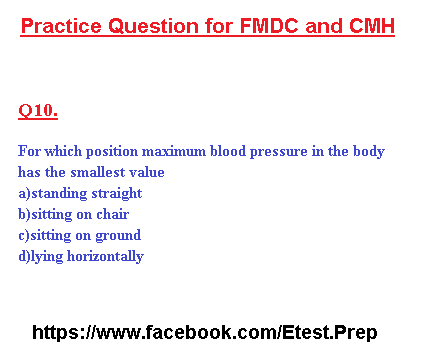
Delta is the answer
While lying horizontally, the body is in relaxed state the arteries are not dilated, furthermore the heart don't have to pump blood against gravity.


Over the train is correct answer.
‘A fast moving train’ these are the key words of this question.
As train is moving fast pressure around it will be low than the outer space, this will cause a pressure gradient. As everything moves from high pressure to low pressure so the man standing near the fast moving train will be drawn towards the train.


The correct answer is 4:9, since the radii are in the ratio of 2:3 and their mass must be unequal if density is constant, the terminal velocity is given by
                                                         vt = (2gr2 ρ)/9η
From above formula it is clear that terminal velocity is directly proportional to the square of radius.
But in book there is one more equation in which terminal velocity is inversely proportional to the radius.
                                                          vt = mg/6πηr
The first equation will be used when density is constant and mass is a variable quantity and second equation is used when mass is constant like in the example of paratroopers where r becomes larger but mass don’t remains the same.


The rotational K.E. is given by
                                                (K.E)rotational = 1/2 Iω2
For hoop I = mr2
So
                                                (K.E)rotational = 1/2 mv2
Which is equal to translational kinetic energy?


The answer is Benzene, which is non-polar. The other three compounds are miscible in water but benzene in water is an example practically immiscible liquids.


An acid weaker than carboxylic acid.
Just recall this trend written in the topic of phenols
Acidic strength :
Carboxylic acids > phenols > water > alcohols
And also remember that inorganic acids like HCl are always stronger than organic ones.


Delta is answer


Divinyl acetylene is the answer. The formula is given in the preparation of Neoprene in Alkyne section just name it according to IUPAC nomenclature.


Addition of HX to unsymmertical alkenes is governed by Markonikov's rule which is a two step mechanism.


Read More

Tuesday, October 29

Practice Questions for FMDC ( Part 1 )

By With No comments:
Answer:  Iron
Reason: Only insulators can be used as Dielectrics within the capacitors in order to make them function properly.   


Answer: 5m/s
Reason: The water in the bucket will not fall down only if the upward force acting on the bucket is equal to the downward force. The force acting in the downward direction is the weight of the water and the force acting in the outward direction is the centrifugal force.
So we get the following expression:
                                         mg = mv^2/r
                                           gr = v^2
                                       v = square root (gr)
Use the values in the above equation, you will get
                                         v = 5m/s approx


Ans: Sulphur .
Reason: The detailed explanation of the above question can be found here : Solution


Answer: Increase by 2%
Reason: According to the formula:
                                               g = GM/R2
means
g is inversely proportional to R2.
So, if R will increase g will decrease and if R will decrease g will increase.
Moreover the change in g will be the twice as compared to R, because g is proportional to R2 . If it had been R^3 the change in g would have been 3 times, if it had been square root R, the change in g would have been 1/2 times to that of R.
So in our case R is decreased by 1%, this shows g should increase by 2%.
There is another procedure of solving this problem by using some maths but that is a lengthy process. Its the shortest and best method i.e solving by analyzing.

The other procedure is explained in the picture below:


Answer: Alpha Particles.
Reason: Here we have to make use of De-broglie's equation:
                                                   λ = h/mv
so,
                                                    v = h/mλ
This shows velocity is inversely proportional to mass and wavelength, in this case wavelength is same for all so the particle with more mass will have the least velocity.
As alpha particle is the heaviest in above mentioned options so it is the correct ans.


Answer: R/4 ohms
Reason: The detailed Solution of this question can be understood from this picture :
https://www.facebook.com/photo.php?fbid=410656699014991&set=a.144657985614865.37547.130470747033589&type=1&relevant_count=1


Answer: 200%
Reason: Kinetic Energy is given by

K.E = 0.5 mv^2
       = 0.5v (mv)
       = 0.5 v P
where P is the momentum. According to the given data Momentum is increased by 100%, which means the momentum is doubled. According to the above equation K.E is directly proportional to the momentum, so if momentum is doubled the K.E will also be doubled in other words our K.E has become 200%. In case the question was what is the change in K.E, then it would have been 100%. Hope its clear.


Answer: 5 mins
Reason: We are to find out how many half lives are involved in this decay and then divide the total time by the number of half lives to get time of one half life.
In one half life 1/2 of the sample decays and 1/2 is left behind. In next half life 1/4 decays and 3/4 is left behind, in next half life 3/8 decays and 5/8 is left behind. So in our case 3 half lives are involved, therefore one half life will be equal to 5 mins.


Answer: 10
Reason: There are many possibilities for this transition,in order to find the maximum possible photons we have to sum them all. Electron can first jump from 5th shell to 4th shell, from 4th shell to 3rd shell, from 3rd shell to 2nd shell and from 2nd to 1st shell.This makes 4 photons.
Another possibility is jump from 5th shell to 3rd shell, from 3rd shell to 2nd shell and then to first shell. In this case. In this case only one new photon is produced i,e from transition from 5th to 3rd. Rest were produced in the last case as well.
Next possibility is that electron can jump from 5th shell to 2nd and then from 2nd shell to 1st. In this case again one distinct photon is produced.
Another possibility is that electron can jump from 5th shell to 1st shell directly. This will produce one photon.
Next possibility is the jumping of electron from 5th shell to 4th shell , from 4th to 2nd and then 1st. This gives one more distinct photon.
Next possibility is the jumping of electron from 5th to 4th and from 4th to 1st. This gives one distinct photon.
Another possibility is the jumping of electron from 5th to 3rd and from 3rd to 1st. This will give one more photon.
These are all the possibilities. Sum these all you will get 10.
Students of Maths can solve this problem using the formula of combination. And for medical students here is the shortcut:
Pair each number with the numbers below it i.e 5 with 4,3,2,1. 4 with 3,2,1 . 3 with 2,1 . And 2 with 1.
I mean this:
54  53  52  51
43  42  41
32  31
21
These all are the distinct photons we got in above possibilities. Add these all you will get the answer equal to 10.

The above lines can be summed up in the figure given below:


Read More
Home Solved Past Papers of NUST Website
Copyright © 2014 Entry Test Preparation | All Rights Reserved. Design By Blogger Templates